
This project of full back tattoo dive into the world of'Art Nouveau, that of ornamental illustrations, ethereal female figures, of compositions designed to inhabit the body. It cannot be told in a single session. It requires time, trust, and a certain idea of what a tattoo can be when it ceases to be an image stuck onto the skin to become something closer to a garment that is never taken off, or of a piece of jewellery that one would wear next to the skin.
This full back project in Black and grey is spot on.
An original illustration in the style of Édouard Bisson
The starting point for this project is a original illustration, a composition entirely conceived and drawn, in a visual universe directly inspired by'Édouard Bisson (1856–1939).
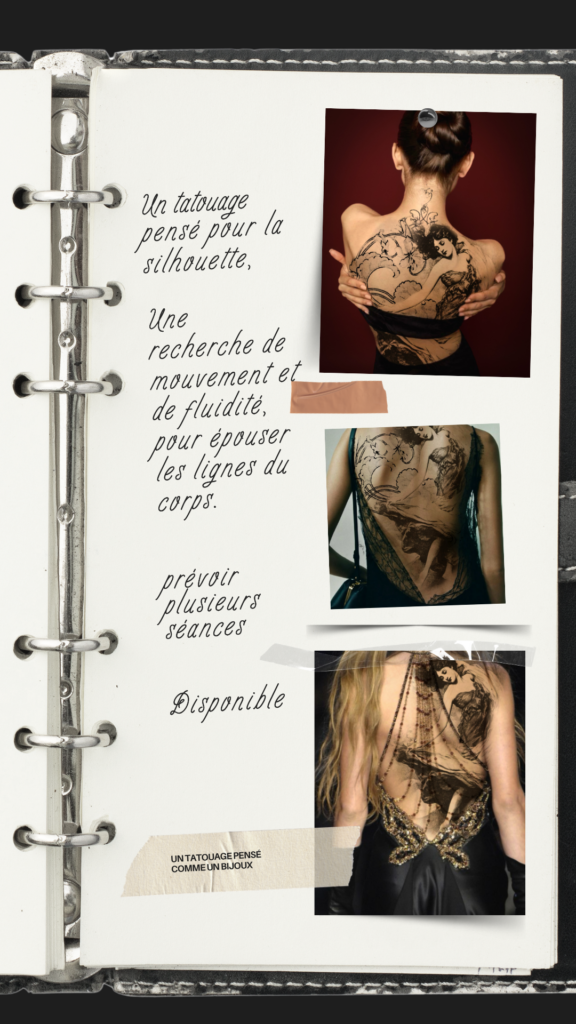
Bisson is one of those Belle Époque illustrators whom history has kept in the shadow of Mucha, but whose work deserves a closer look. His women have something'ethereal and sensual at the same time, they float within dense ornamental compositions, surrounded by scrolls, stylised flowers and drapery that seem caught in the wind. This is not the Art Nouveau of geometric rigidity: this is the Art Nouveau of movement, grace, breath.
It is this very register that feeds the initial illustration, and it is this same register that will inhabit the back.
The back as a canvas — but not just any canvas
The back is a surface that is both generous and complex. It offers space, but it is not flat: it hollows out, it arches, it contracts. The spine creates a natural axis. The shoulder blades draw a topography that any composition worthy of the name must integrate if it truly wants work on the body — and not simply exist on it. That is precisely what makes tattooing much more than just an image: the body as a cultural surface, vibrant, in constant motion.
What makes Bisson's universe particularly well-suited to this type of project is that his compositions already bear this organic movement logic, characters are never static, ornaments are never rigid. They twist, they spill over slightly, they breathe. Translated into a full-back tattoo, these elements can follow the morphology rather than contradicting her.
The expected result: a tattoo which, seen from behind, looks like a ancient illustration come straight to live on the skin. Something between engraving and lace. Between art and adornment.
Designed like a jewel
The formula sums up quite well the intention behind this project: a tattoo conceived as a piece of jewellery. Not in the superficial ornamental sense of the term, in the sense of an object designed to adorn the body, which flatters the silhouette, which follows the natural lines, which truly only exists worn.
A piece of jewellery is not just looked at flat on a surface. It takes on its meaning in movement, in the light, in its relationship with the body that wears it. A successful full-back tattoo works in the exact same way: it reveals itself with movement, with posture, with the way the skin stretches or relaxes. It is this intention that guides all the thought process behind placement and composition, and this is precisely what I mean by the composition logic characteristic of Art Nouveau to conceptualise the image for the body, not independently of it.
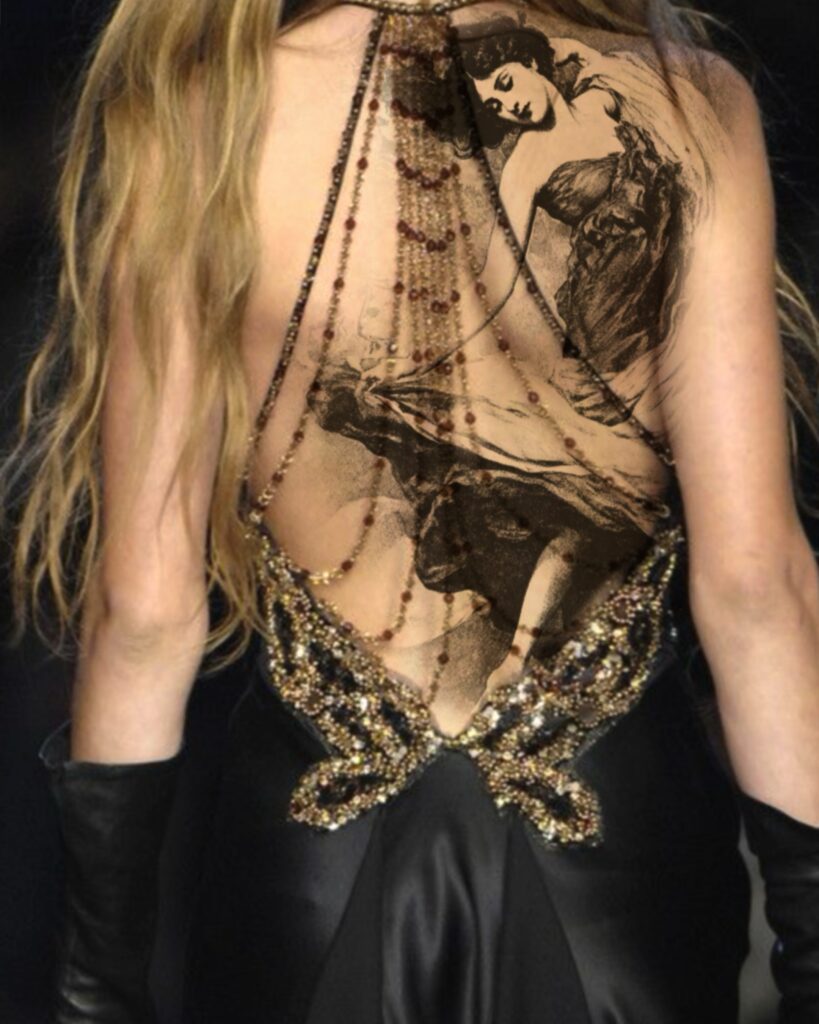
Black and grey: the choice of finish
This project is designed exclusively in Black and grey. This is the choice that best fits the reference aesthetic. Bisson's work is that of engravings, lithographs, works in ink, images that derive their depth from contrast and nuance. I have another project available in the same universe, which is entirely in colour, with pastel tones, you can see it here in my article: Decorate the body.
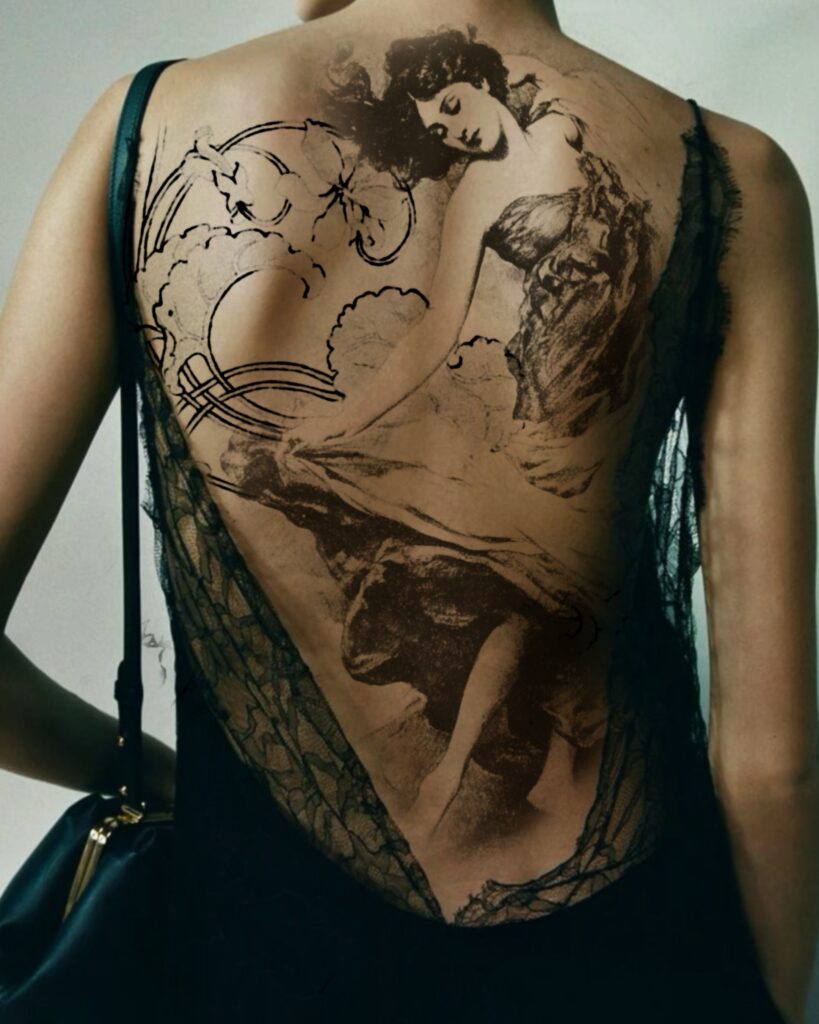
In black and grey, we work on the modelled, the gradients, the depth of the shadows, the lightness of the highlighted areas. You can render the delicacy of a face in the style of an antique engraving while creating dark, dense masses in the ornamental areas. It's technically demanding, and that's precisely what makes this type of project interesting to tattoo.
What this means in practice
A complete back of this nature is carried out over several sessions. It is inevitable, and it is not a constraint, it is a condition for achieving a result that lasts over time and in quality. We work by areas, respecting the healing process, maintaining consistency in the finish between each session. For a project of this scale, choose the right tattoo artist, someone whose artistic universe really matches what we are looking for, is just as important a step as the project itself.
This project forms part of the Art Nouveau approach that I am developing at the studio Graphicaderme from Avignon. A way of thinking about tattooing as a constructed, organic image, designed to last. It is available. To discuss this, talk about morphology, intentions, and what we can build together, simply get in touch via the form.
A full backpiece of this nature generally requires between 3 and 6 sessions, depending on body shape, pain tolerance and the complexity of the areas worked on. Each session allows progress to be made in coherent areas, whilst respecting the healing process.
Yes — that is even the founding principle of this project. The composition is designed to follow the lines of the body, not to be plastered onto it. An initial discussion about silhouette and proportions is an integral part of the process.
No. This project is conceived exclusively in black and grey — it is a deliberate artistic choice, directly linked to the aesthetic of the illustrations that inspire it. Changing the rendering would fundamentally alter the spirit of the project.
To a certain extent, yes. The discussion during the consultation allows certain details to be adjusted according to personal preferences and body shape. However, the general structure and spirit of the composition remain fixed, which is what guarantees the coherence of the final result.
Via the contact form, on the website. An initial discussion helps to define the project before setting a date.

0 commentaires
Be the first to leave a comment.
Comments are closed on this post.