
Hello everyone!
One of the questions that often comes up when I show my colour tattoos is inevitably: "But is it going to stay like that?" The short answer is no. A tattoo never stays exactly like the day it was done, and that is not necessarily a bad thing.
Skin lives, it moves, it renews itself, it catches the sun, it ages with us. Pigments therefore inevitably change too. Colours become softer, blacks lose their first-day intensity and lines can thicken slightly over time.
What interests me above all is not trying to completely prevent this change — that's impossible — but designing the tattoo from the very beginning so that it stays beautiful and legible when it happens.
The colour doesn't disappear overnight
A freshly done colour tattoo is bound to be much more vibrant. The skin has just been worked on, the pigments are very prominent and everything looks more contrasted. Once healed, the final look already becomes a bit softer.
Then over the years, the colours can gradually lose their intensity. Black also evolves: it becomes less deep and softer. This is normal and affects all tattoos, not just colour ones.
That’s also why I’ve never really liked the idea that "black ages well and colour ages badly". For me, it’s much more about the line work, contrast, skin and the way the tattoo was conceived.
It all starts at the moment of drawing
Even before choosing the pigments, I think first about the structure. If the design is too tight, too filled in or if all the lines are crammed together against one another, it will have much less room to age properly over the years.
I like to leave some breathing space in a composition, have shapes that remain readable from a distance and contrasts that are clear enough for the tattoo to retain its presence even when the colours soften a bit.
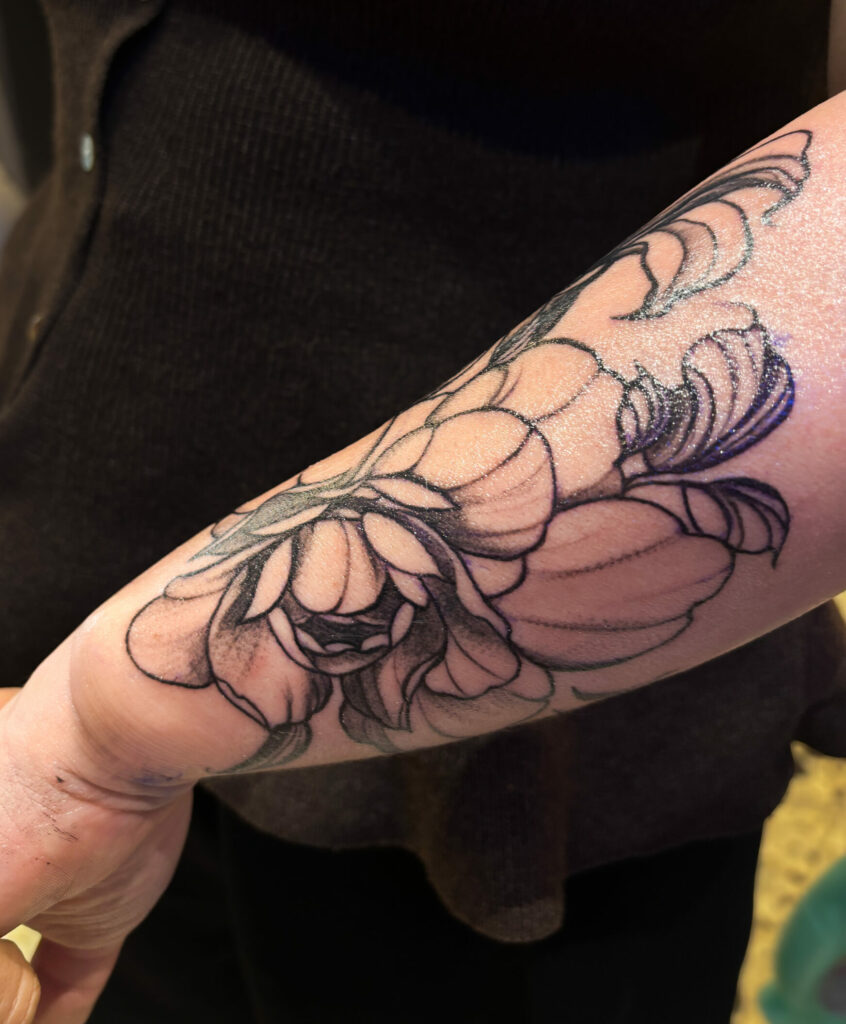
This is particularly important in the Art Nouveau projects I do, because there are often huge amounts of detail, hair, flowers, ornaments and curves. If you want to put everything on the same level, you very quickly end up with something unreadable.
Why lines can appear thicker over time
Skin is not a sheet of paper. Over the years, lines may widen slightly and the small spaces between two elements may appear less significant than at first.
That's why I avoid building my tattoos solely on micro-details that look great on a phone screen but won't be as legible a few years down the line.
When a composition is strong right from the start, it can evolve without losing what makes its identity. That is really what I am looking for.
The sun plays a huge part
I often repeat this after sessions: once the tattoo has healed, the sun becomes one of the major factors to watch out for if you want to preserve the colours.
I therefore protect my tattoos when they are exposed, especially in the summer. You can never completely stop time, but protecting your skin at least avoids unnecessarily accelerating the ageing of the pigments.
And of course, it all starts with proper healing. I’ve put together my current routine in my article on aftercare.
What I particularly like about a tattoo that has aged
I find we sometimes have a rather strange view of tattooing on Instagram, because we mostly see photos taken right after the session: saturated colours, shiny skin, very deep blacks. It's obviously gorgeous in a photo, but that's not how a tattoo is going to look in everyday life for twenty years.
A healed tattoo becomes softer and blends more into the skin. And personally, I also like this evolution. I prefer a tattoo that has lived well, remaining legible and harmonious, rather than an image designed solely to be spectacular for the twenty minutes following the session.
Colour has taken on a huge role in my work in recent years, to the point that in 2025 I won an award for colour tattooing at the Avignon Convention. This is precisely what drives me to keep thinking about how colours are built, how they complement each other and how they will evolve on the skin.
FAQ: ageing of a colour tattoo
Do coloured tattoos fade over time?
It does not disappear, but the colours can gradually lose their intensity. The black also changes and generally becomes softer over the years.
Do black tattoos age better than coloured tattoos?
Not necessarily. For me, how well it holds up depends mostly on the design's structure, the contrasts, the skin, sun exposure, and how the tattoo was done and cared for.
Why do tattoo lines thicken?
Over time, lines can spread slightly in the skin. This is one of the reasons why it is important to leave enough space between elements right from the tattoo design stage.
How to preserve the colours of a tattoo?
Good healing right from the start and regular sun protection once the tattoo has healed are among the most important habits for avoiding the unnecessary acceleration of pigment alteration.










0 commentaires
Be the first to leave a comment.