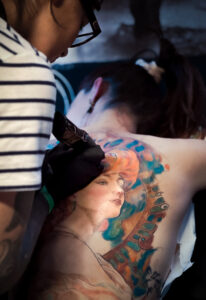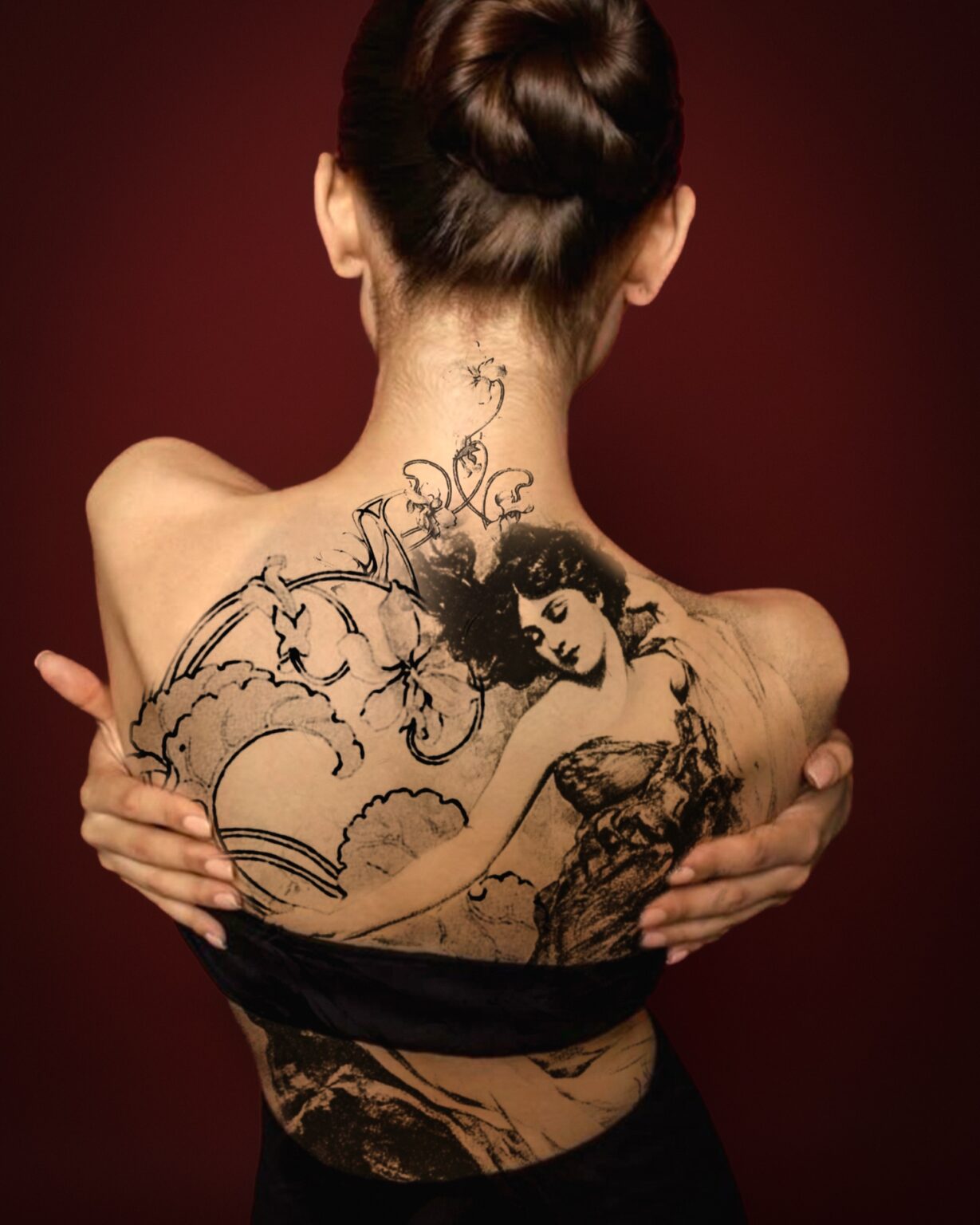
This black and grey back tattoo project sits in the universe of Art Nouveau, ornamental illustrations, aerial feminine figures, compositions designed to inhabit the body. It doesn't fit into a single session. It asks for time, trust, and a particular idea of what a tattoo can be when it stops being an image placed on skin and becomes something closer to a garment you never take off, or a piece of jewellery worn directly against the flesh.
An original illustration in the spirit of Édouard Bisson
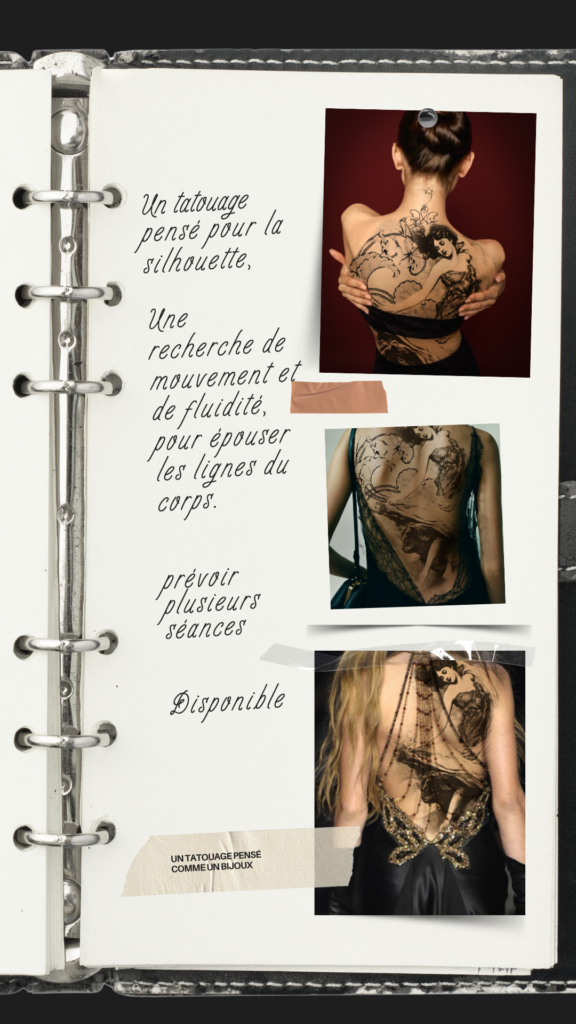
The starting point for this project is an original illustration — a composition entirely conceived and drawn within a visual universe directly inspired by Édouard Bisson (1856–1939).
Bisson is one of those Belle Époque illustrators that history has kept in Mucha's shadow, but whose work deserves attention. His women have something simultaneously aerial and sensual — they float in dense ornamental compositions, surrounded by scrolls, stylised flowers, drapery that seems caught in the wind. This isn't the Art Nouveau of geometric rigidity. It's the Art Nouveau of movement, grace, breath.
That's the register that feeds the original illustration — and that's the register that will inhabit the back.
The back as a canvas but not just any canvas
The back is both generous and complex as a surface. It offers space, but it isn't flat — it hollows, arches, contracts. The spine creates a natural axis. The shoulder blades create a relief that any serious composition must integrate if it's going to truly work on the body rather than simply exist on top of it. This is what makes tattooing more than an image: the body as a cultural surface, alive, in constant movement.
What makes Bisson's universe particularly well suited to this kind of project is that his compositions already carry that organic logic of movement — figures are never frozen, ornaments are never rigid. They coil, they spill slightly, they breathe. Translated onto a full back, these elements can follow the morphology rather than contradicting it.
The intended result: a tattoo that, seen from behind, reads like an antique illustration that has come to inhabit the skin. Somewhere between engraving and lacework. Between art and adornment.
Designed like a piece of jewellery
That phrase sums up the intention behind this project: a tattoo designed like a piece of jewellery. Not in a superficially decorative sense — in the sense of an object conceived to adorn the body, that accounts for the silhouette, that follows natural lines, that only truly exists when worn.
Jewellery doesn't make sense lying flat on a surface. It finds its meaning in movement, in light, in its relationship to the body carrying it. A successful full back tattoo works in exactly the same way, it reveals itself through movement, through posture, through the way skin stretches and relaxes. This is precisely what I mean by the compositional logic of Art Nouveau: thinking the image for the body, not independently of it.
Black and grey: the choice of rendering
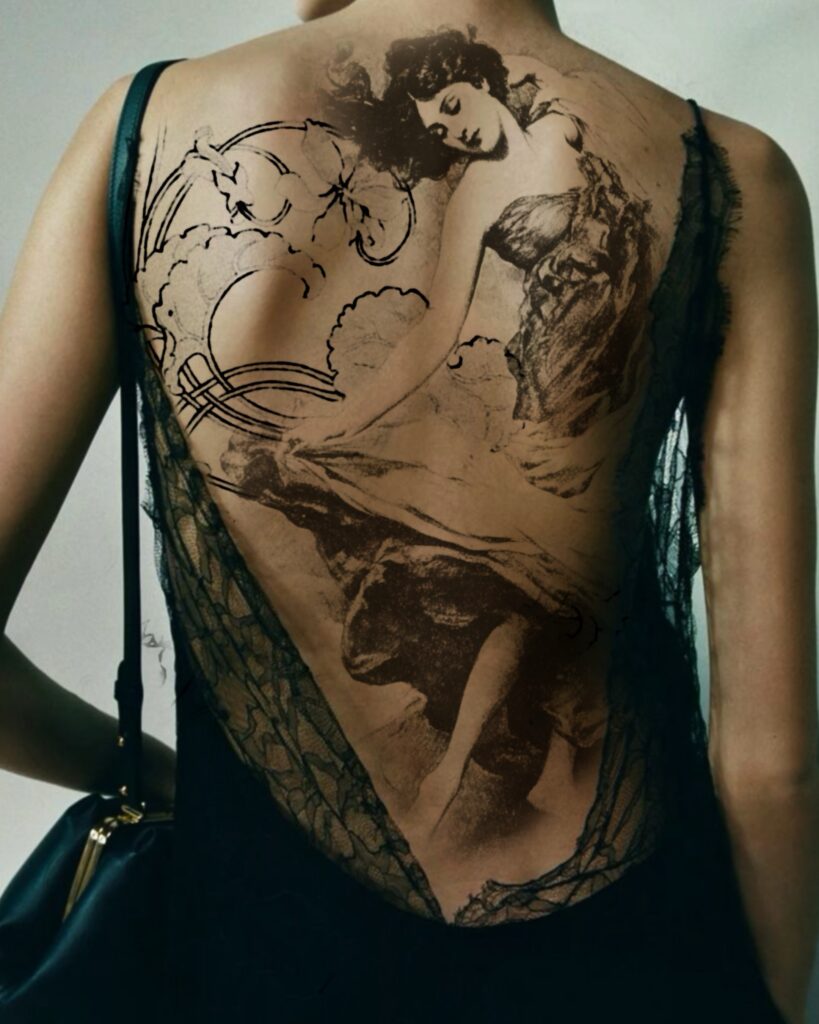
This project is conceived exclusively in black and grey. It's the choice that best matches the reference aesthetic. Bisson's work is that of engravings, lithographs, ink drawings, images that draw their depth from contrast and nuance. I also have another project available in the same universe, this time entirely in colour, you can discover it here: Adorning the body.
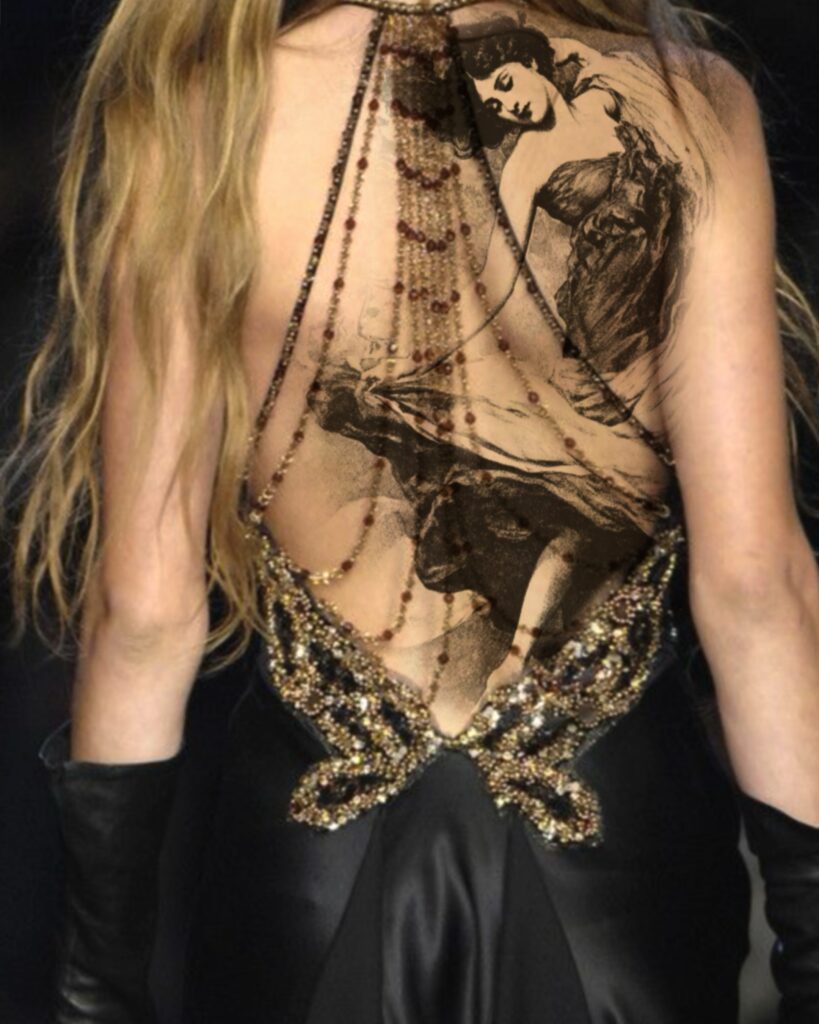
In black and grey, we work the modelling, the gradients, the depth of shadows, the lightness of clear areas. We can render the delicacy of a face in the manner of an antique engraving while creating dark, dense masses in the ornamental zones. It's technically demanding, and that's exactly what makes this kind of project interesting to tattoo.
What this means in practice
A full back of this nature is realised over multiple sessions. That's inevitable, and it isn't a constraint, it's a condition for achieving a result that holds over time and in quality. We work zone by zone, respecting the healing process, maintaining consistent rendering between sessions. For a project of this scale, choosing the right tattoo artist is as important as the project itself.
I'm based at Graphicaderme studio in Avignon and regularly travel for projects and conventions. If you're based in London and interested, feel free to get in touch, we can find a way to make it work. The project is available. To discuss morphology, intentions, what we can build together, reach out via the contact form.
A full back of this nature generally requires between 3 and 6 sessions, depending on morphology, pain tolerance and the complexity of the areas being worked. Each session progresses through coherent zones, respecting the healing process.
Yes, that's the founding principle of this project. The composition is designed to follow the body's lines, not to be imposed on them. A preliminary exchange about silhouette and proportions is an integral part of the process.
No. This project is conceived exclusively in black and grey — a deliberate artistic choice directly linked to the aesthetic of the illustrations that inspire it. Changing the rendering would fundamentally alter the spirit of the project.
To some extent, yes. The consultation allows for adjustments to certain details based on personal preferences and morphology. The overall structure and spirit of the composition remain fixed.
Yes. I regularly travel for projects and conventions. If you're based in London and interested in a project, feel free to get in touch, we can find a way to make it work.
Via the contact form or directly on Instagram.