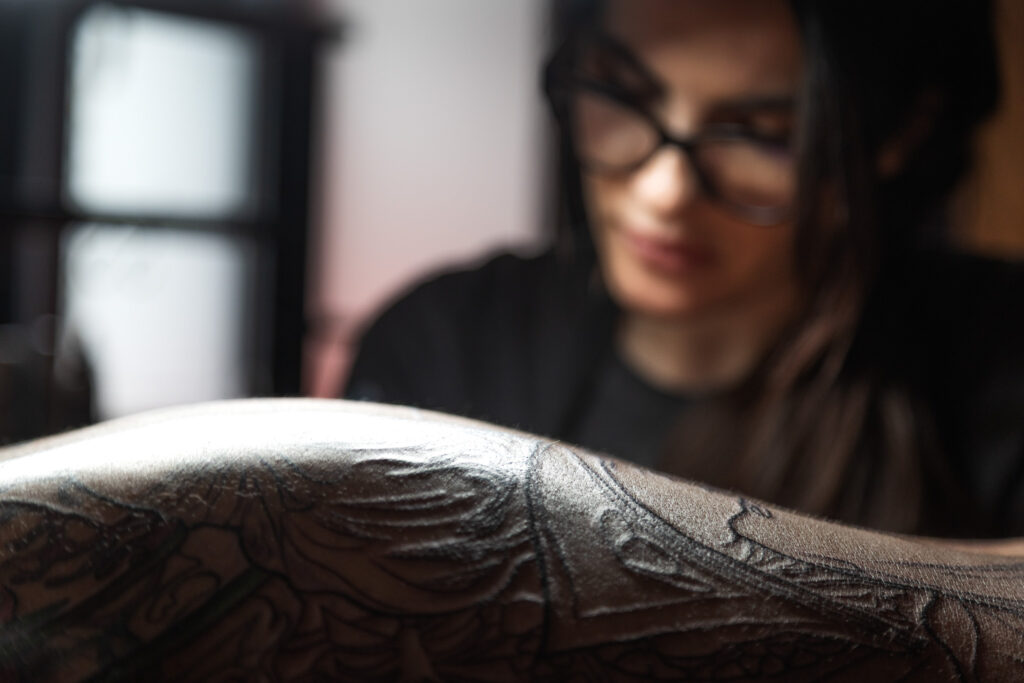
The tattoo before it's a pattern
We often talk about styles, trends, and references. But honestly, a tattoo isn't just about its subject matter. It's about its construction.
What interests me is to refuse decorative accumulation. To seek a composition that exists in itself. A balance, a tension, a presence. As Hector Guimard, one of the major architects of the'Art Nouveau "Nature does not make straight lines." That's exactly what I'm trying to apply to skin. Lines that follow the body, that accompany it rather than lie on it.


Structure first
Before talking about flowers, portraits, or symbols, I consider the structure. Where does the main mass sit? Where does the image breathe? What's the guiding line? It's like everything, ultimately. Clothing style, flat decor, a website's art direction, a living room's atmosphere. Everything that endures is based on considered structure, not on an accumulation of good ideas placed one on top of another.
The composition is invisible when it's successful. But it supports everything else. It determines the strength of a tattoo long after the immediate effect of novelty. And that's exactly what I want.
The body is not a flat sheet
The body has natural volumes, movements, and tensions. A piece must follow an arm, a back, a thigh, without becoming a collage. This cannot be improvised. It requires careful reading of morphology and constant adaptation. This is what I concretely explore in This colourful peacock tattoo on the back.

What Art Nouveau brings me in concrete terms
Art Nouveau and Art Deco are not styles to be reproduced. They are ways of understanding imagery. A precise line, a considered structure, a mastered composition.
In tattooing, this rigour allows for the creation of pieces that will stand the test of time. Not solely through their immediate visual effect, but through their internal logic. It is also what attracted me to Tamara de Lempicka. The same formal requirement, the same attention to the strength of the figures.
Less is often more
A strong tattoo does not need to be loaded to exist. It must hold by its presence.

Contrast management, grain, density. Sometimes removing is more important than adding. White space is as integral to the composition as ink. This is what I applied to the Portrait of Madame Boucard.
What that changes in my work
Every project begins with a clear intention. I don't just aim to fulfil a request, but to understand what the image needs to convey.
Line, rhythm, balance guide my choices. Pattern comes next. A well-considered tattoo doesn't seek to impress immediately. It imposes itself gradually, through its stability and presence.
This project was carried out in the studio Graphicaderme from Chaudes-Aigues at Gourmet & Glouton, where I regularly work during my dates in the Cantal. You can also find my next availabilities in Chaudes-Aigues here.
→ See the portfolio
It determines the overall balance. Even a simple pattern can lose its impact if it's poorly structured. A clear construction allows the image to remain legible and coherent over time.
The design must take into account volumes, movements, and natural lines. A well-thought-out tattoo should complement the morphology rather than fight it.
Yes. It brings rigour to the line and structure. It allows composition to be thought of as a coherent whole rather than an assembly of elements.
Simplicity is not an absence of work. It enhances the presence of an image. A streamlined composition can be stronger than an accumulation of details.
Yes. An image conceived in terms of balance, contrast, and structure remains more visually stable, even after several years.
0 commentaires
Sois la première personne à laisser un commentaire.