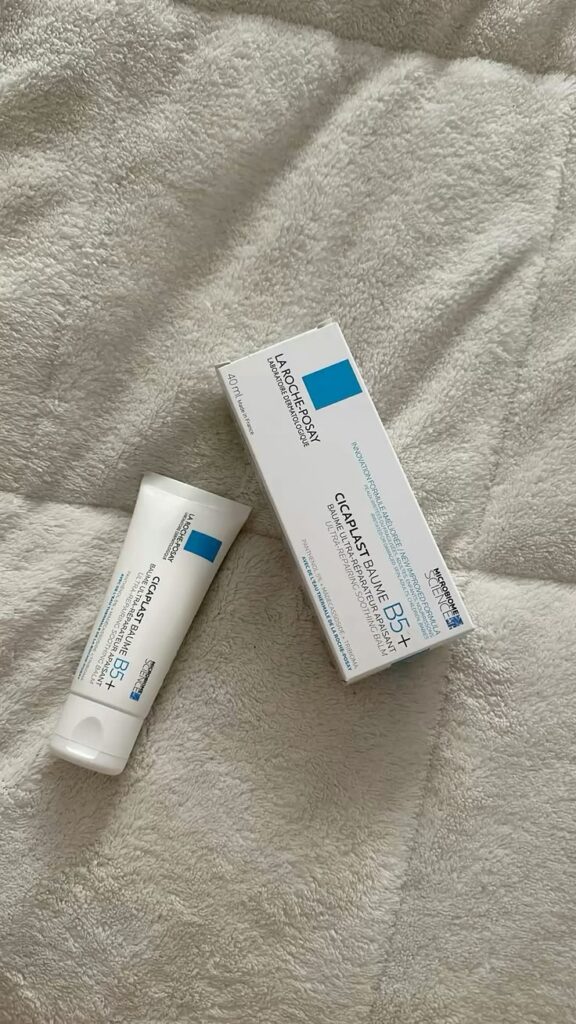
Cicaplast La Roche-Posay tattoo: when and how to use it
Before we go any further on the "Cicaplast" product for tattoos from La Roche-Posay, if you're starting your healing process, I advise you to read my A comprehensive guide to aftercare for tattoos
After a tattoo, the question of aftercare always comes up, particularly that of cream. Among the products often mentioned, La Roche-Posay Cicaplast is regularly cited for its role in supporting wound healing.
But is this type of cream really suitable for a tattoo, and most importantly, when should it be used?
In this context, La Roche-Posay sent me to the studio Graphicaderme samples of Cicaplast, in gel and in balm. I tested them directly on healing tattoos.
A scar healing cream is not effective from the outset
A tattoo involves skin that has been worked deeply. In the first few days, the skin is still open and in a reactive phase.
During this period, the aim is not to “repair” immediately, but to allow the skin to close gradually, while maintaining simple hygiene.
This is why a cream such as Cicaplast It is not used from the first few days. Applied too early, it does not provide any particular benefit and can even make the skin feel heavy.
Cicaplast tattoo: when to use it during the repair phase
When the skin begins to close up, usually after a few days, healing enters a more stable phase.
It is at this point that restorative treatments come into play.
Cicaplast, available in gel and balm, is formulated to support this phase. The lighter gel can be used to cleanse and soothe the area without weighing down the skin.
The richer balm provides more comfort to areas that are still dry or sensitive. It should be used once the skin has already closed well after the skin breakage, ideally around the fourth day.
In both cases, the objective remains the same: to maintain supple skin without disrupting the natural healing process.
A use that relies on the correct dosage
A cream's effectiveness doesn't depend solely on its formulation, but also on its usage.
Applying it too liberally can slow down healing by preventing the skin from breathing properly. Conversely, applying it lightly can support the process without disrupting it.
When it comes to tattoos, the rule is simple: a thin layer is enough.
A complementary product, not a standalone solution
The use of Cicaplast fits into a global routine.
It does not replace essential actions, such as cleaning or respecting healing phases. It serves as a supplement, at a specific time.
It is this consistency in care that allows for a stable and lasting outcome.
To understand the full protocol, see my article on aftercare and also on the website Graphicaderme.
Conclusion
Healing creams like La Roche-Posay Cicaplast can aid tattoo healing, provided they are used at the right time.
They do not constitute a solution in themselves, but rather support in an already ongoing phase.
In tattooing, as in skincare, the result relies above all on respecting the natural healing rhythm. You can find more information on Cicaplast products on the Graphicaderme studio website. here.
No. In the early days, the skin is still open and in a reactive phase. Applying Cicaplast too soon offers no benefit and can weigh down the surface. It is a second-phase treatment, not a starting one.
From about the fourth day, when the skin starts to close over. That's when repair care really comes into its own.
The gel is a pH-neutral soap, designed to cleanse the area. The balm is richer and is used to moisturise. It's best used when the skin has already closed over but is still dry or sensitive.
A thin layer is sufficient. Too much cream will prevent the skin from breathing and can slow down healing. Less is always more in this instance.
No. It's a useful supplement at a specific moment, not a solution in itself. It integrates into a global routine that begins with cleansing and respecting healing phases. For the complete protocol, see the Aftercare guide.
La Roche-Posay sent me samples to the studio Graphicaderme. Tests were carried out on actual scars. The opinion remains my own.

0 commentaires
Sois la première personne à laisser un commentaire.