Choosing your tattoo artist is a decision that deserves thought.
A tattoo is not just a motif, it's an image that will stay and live on the body. That image depends as much on the visible result as on the way it is conceived and executed.
The portfolio — not just for the style, but to understand the coherence of the work over time. A good portfolio shows a clear artistic direction, not a collection of trends.
The quality of the exchange — the first contact says a lot. A serious tattoo artist takes the time to understand your project, asks questions, and doesn't hesitate to redirect if necessary.
The studio — hygiene, organisation, stability of the space. A professional environment doesn't need to overdo it: it is simply coherent and controlled.
The fit with your project — the "best tattoo artist" doesn't exist. What matters is that their way of building an image matches what you have in mind.
The aftercare follow-up — a real professional doesn't disappear once the needle is down. Precise healing advice, availability if needed: that's where the seriousness of the work shows.
Style attracts, but it's not enough
The portfolio allows you to understand a direction, a sensibility, a way of drawing. Yet it only shows part of the work. It says nothing about how a project is constructed, how an image is adapted to a body shape, or how seriously it is thought through over time.
A tattoo is not judged solely on its immediate result. It also needs to be thought through for how it will evolve over time. I go into more detail in my article on how a colour tattoo ages.
Two tattoo artists may produce similar-looking images, but their approach can be completely different — and it's precisely that approach that makes all the difference.
The meeting: the real starting point
Everything really begins at the moment of the meeting.

The way a project is received, the questions asked, the time taken to understand what the person wants and needs, these are all essential indicators. A tattoo should never be executed without thought.
It needs to be built, adjusted, sometimes even redirected. When the exchange is quick, imprecise or superficial, it often means the project won't be developed thoroughly enough.
The studio: a space that doesn't lie
Walking into a studio gives you an immediate sense of what kind of environment you're in. The organisation, hygiene, stability of the space, the way things are kept — all of this gives a very clear reading of the seriousness of the work.
A professional studio doesn't need to overdo it, it is simply coherent, functional and controlled. You quickly sense whether you're in an established space or something more fragile, and that impression is rarely wrong.
The feeling: a concrete foundation
Feeling is often described as something instinctive, when in reality it's built on very concrete elements. It's constructed through the exchange, the quality of listening, the clarity of answers, the tattoo artist's ability to take a position.
A professional doesn't try to say yes to everything. They know how to guide, adjust, and refuse when a project isn't coherent. That's the kind of rigour that creates a solid relationship of trust.
How to find the right tattoo artist for your project
Looking for the "best tattoo artist" isn't necessarily relevant. What matters is finding the one who genuinely fits the project. Every tattoo artist has a way of building an image, managing placement, thinking a tattoo through over time.
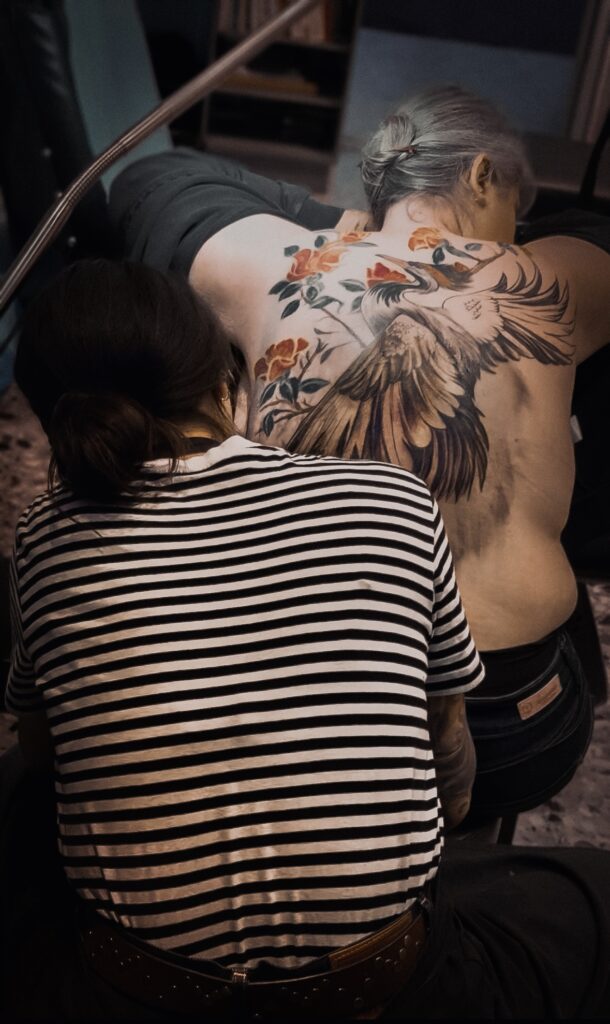
When that way of working aligns with the idea you have, the project naturally becomes more coherent and more right.
Aftercare follow-up
The work doesn't stop at the end of the session. Healing is an integral part of the tattoo and directly influences its final result.
A serious framework includes precise, tailored advice and a presence after the work if needed. It's often in that continuity that real professionalism shows.
A serious professional continues to develop — which is also what I took from the Shane O'Neill seminar in Avignon.
The role of the studio: stability and follow-up
A stable, registered, year-round studio allows for real, reassuring follow-up. It's a reference point, an anchor where you can come back, ask questions and be supported over time.
That framework isn't secondary, it structures the whole experience.
Graphicaderme Avignon: an approach built over time
If you'd like to discuss a project or understand how it can be built, Graphicaderme studio in Avignon welcomes projects by appointment and supports every step, from initial reflection through to aftercare.
Start with the portfolio,not just for the style, but to understand the coherence of the work over time. Then, the first contact says a lot: a serious tattoo artist takes the time to understand your project before proposing anything.
Price often reflects experience and quality. A cheap tattoo can cost a lot more to fix. What matters is the long-term value of the work.
Not necessarily. What matters is that their way of building an image matches your project. A good tattoo artist knows how to adapt their approach, even if specialisation can be a plus for certain complex projects.
Hygiene, organisation and the stability of the space speak for themselves. A professional studio doesn't need to overdo it, it is simply coherent and controlled.
Yes, but it's complex. It's better to take the time to choose well from the start, especially for a multi-session project.