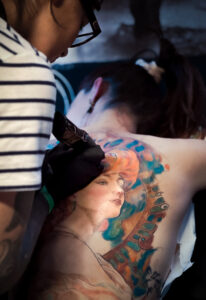
How I think about a tattoo
A tattoo isn't just something you place on skin. Nearly 1 in 4 adults in the UK has at least one now, and the conversation around what people actually want has shifted a lot. People are thinking more carefully. They want something that holds up, that makes sense on their body, that they'll still love in ten years.
That's exactly where I come in.
What interests me isn't just the drawing itself, it's how it sits on the body. How it follows a line, a posture, a movement. How it still looks right years down the line, not just on the day. Every project I take on in London starts from that same place.
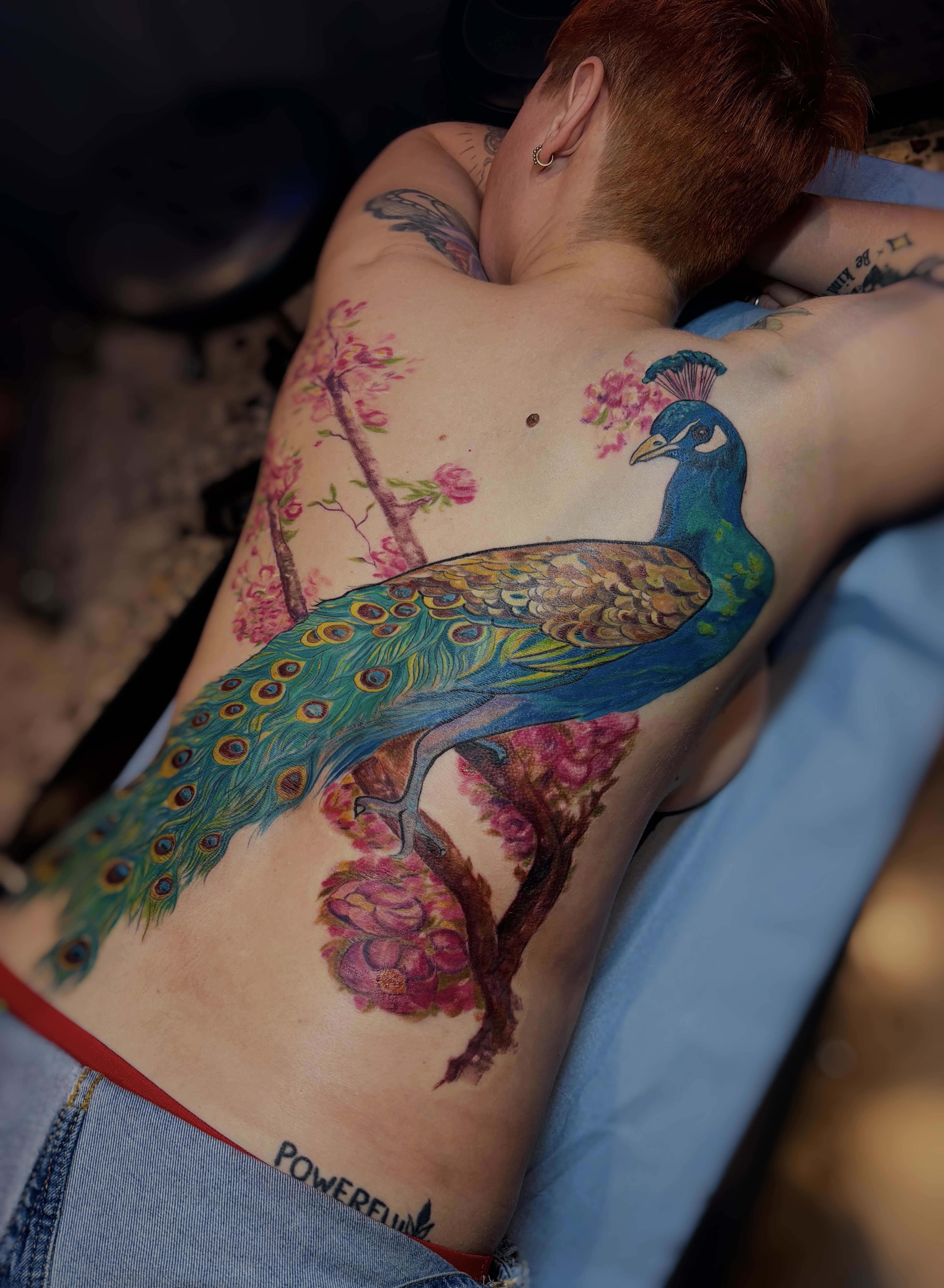
People come to me with very different starting points. Some arrive with a precise idea, others with something vaguer, a mood, a painting they love, a feeling they can't quite put into words. Both work. The process is the same either way: figuring out what needs to stay, what needs to shift, and what will make the image feel genuinely right on skin.
Working from paintings
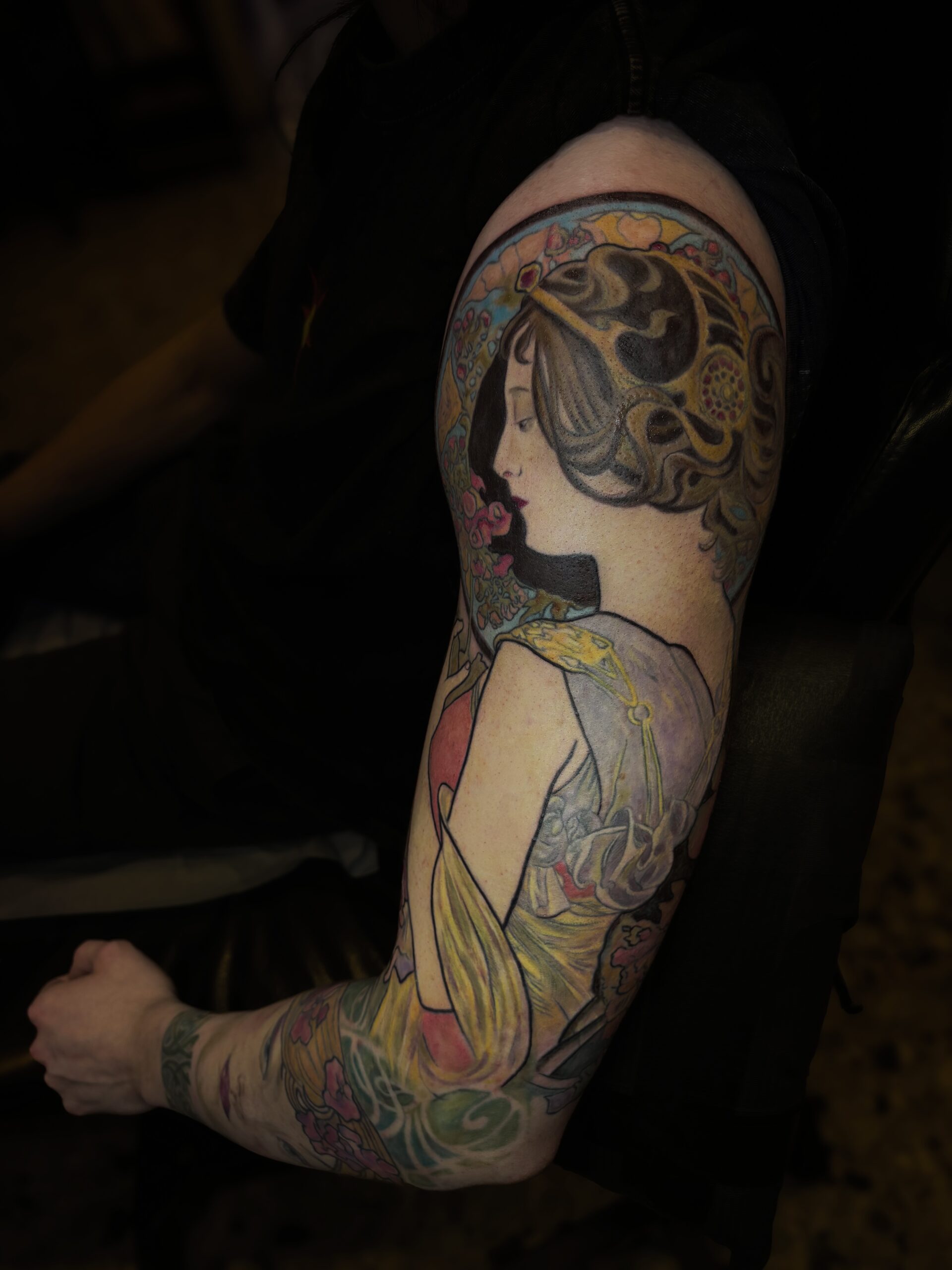
Sometimes I start from a painting. Alphonse Mucha said it best: "Line is the foundation of all composition." That principle runs through everything I do.
Some works already have a tension, a structure, a way of guiding the eye that translates really naturally into tattooing. It's never about copying an image directly. It's about understanding what gives it presence, and working out how that strength can move onto skin.
Alphonse Mucha for line and composition, Tamara de Lempicka for structure and the strength of form, Édouard Bisson for a certain painterly softness. Caravaggio for light and contrast, Dalí for when a project needs something more unhinged. The reference is never the point — what it does on the body is.
Art Nouveau, colour and neo-traditional
My work tends to land somewhere between a few different directions. Art Nouveau for its fluid lines and organic compositions that actually sit well on a body. Colour for depth, contrast, light — everything it opens up in a piece. Neo-traditional for structure and the kind of solidity that keeps a tattoo readable over time.
None of these are labels. They mix differently in every project. Some pieces are more constructed, more decorative, more fluid. Others are more direct, more graphic, more grounded. What always matters is the coherence of the whole. As the Victoria & Albert Museum notes, Art Nouveau was the first truly international style, and that staying power is exactly what I'm looking for in a tattoo.
Thinking about time
A tattoo that works is one that holds up. The balance of contrast, the space left for breathing room, the way the eye moves through it, all of that matters as much as the idea itself. It doesn't need to be loaded to be strong. It needs to be right.
Booking a session in London
I work as a guest artist in London, available for large projects, full sleeves, back pieces and custom work. If you have something in mind, a precise idea, a painting reference, or just a direction — get in touch via the contact form or have a look at the portfolio first.
The choice of style depends on the project and how it should integrate with the body. Approaches such as Art Nouveau, colour and neo-traditional allow pieces to be built with movement and good longevity.
Yes, certain paintings can serve as a starting point. The key is adapting them so they work on the skin, reworking the lines, contrasts and composition.
Longevity depends on several factors: the construction of the tattoo, the balance of contrasts, the area of the body and aftercare. A well-designed composition stays legible longer.
Not necessarily. A direction, a feeling or a few references are enough to start building a coherent project.
The simplest way is to send a message with the area to be tattooed, references if possible and some information about the project, so I can suggest a suitable direction.