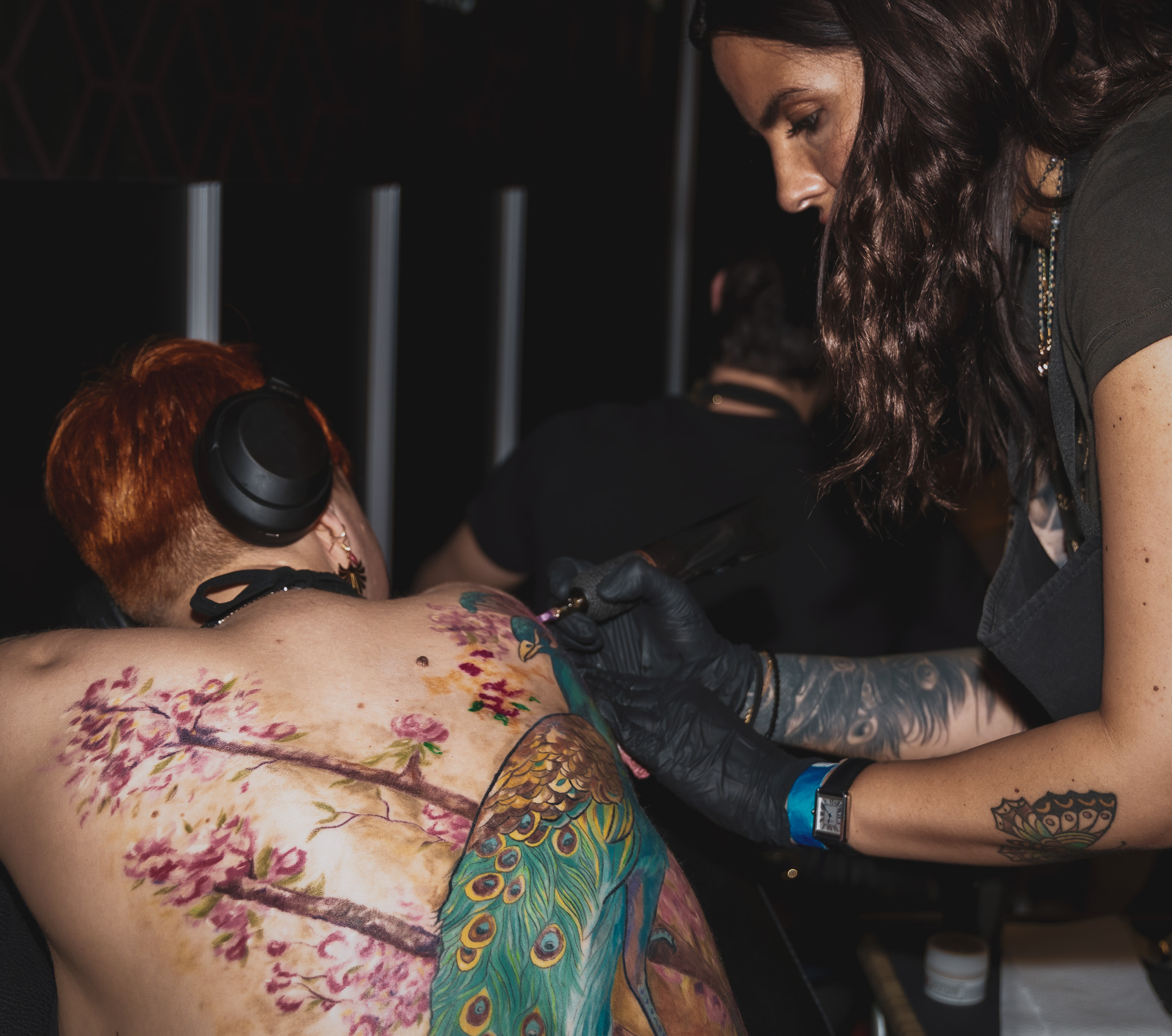
Structure, readability and skin evolution
A tattoo changes over time. That is unavoidable. The skin lives, renews itself and moves, and pigments evolve along with it. Colour gradually fades, black loses its initial depth and becomes more greyed, while lines slowly thicken. These changes are normal and affect all tattoos, whether they are done in colour or in black.
What actually changes over time
As the years go by, pigments do not disappear, but their appearance shifts. Colours lose intensity, blacks are no longer a deep solid black, and contours gain a bit of width. The skin itself changes, and the tattoo follows that transformation. This is not a flaw, but a physiological reality tied to how skin functions.
Structure is decided at the sketch stage
Everything starts with the sketch. The sketch is the structure of a tattoo, and without structure there is no readability. Before colour, before black, before even thinking about skin, there is the drawing. If the structure is not clear at this stage, the tattoo will not hold up over time, regardless of the quality of the ink or the technique used.
How the skin transforms the drawing
Over time, lines naturally expand and the spaces between elements become narrower. This is why tattoos that are too fine, too dense or too tightly packed tend to blur as years pass. This process has nothing to do with colour versus black. It is directly linked to how the drawing was designed to live on skin.
Colour and black facing the same reality
Colour does not age worse than black. It fades, while black turns grey. The process is different in appearance, but the logic is the same. What determines whether a tattoo remains readable is not the choice of pigments, but the clarity of the structure. A poorly structured tattoo will lose definition over time, whatever the palette. On the other hand, a clear and well composed drawing can lose intensity without losing its meaning.
Why some tattoos remain readable
Tattoos that age well have been designed with time in mind from the very beginning. Their sketch is readable, the shapes are clear, and the spaces between elements have been anticipated. Colour and shading then come in to support that base, never to replace it. Readability cannot be fixed later; it is built at the drawing stage.
What time ultimately confirms
A tattoo is never identical to what it was on the first day. Colour softens, black becomes more muted, and lines thicken slightly. But when the structure is solid, the tattoo remains readable and coherent over time. Time does not create a good tattoo. It simply confirms the quality of the structure established at the sketch.